
President Oaks One Year Agenda
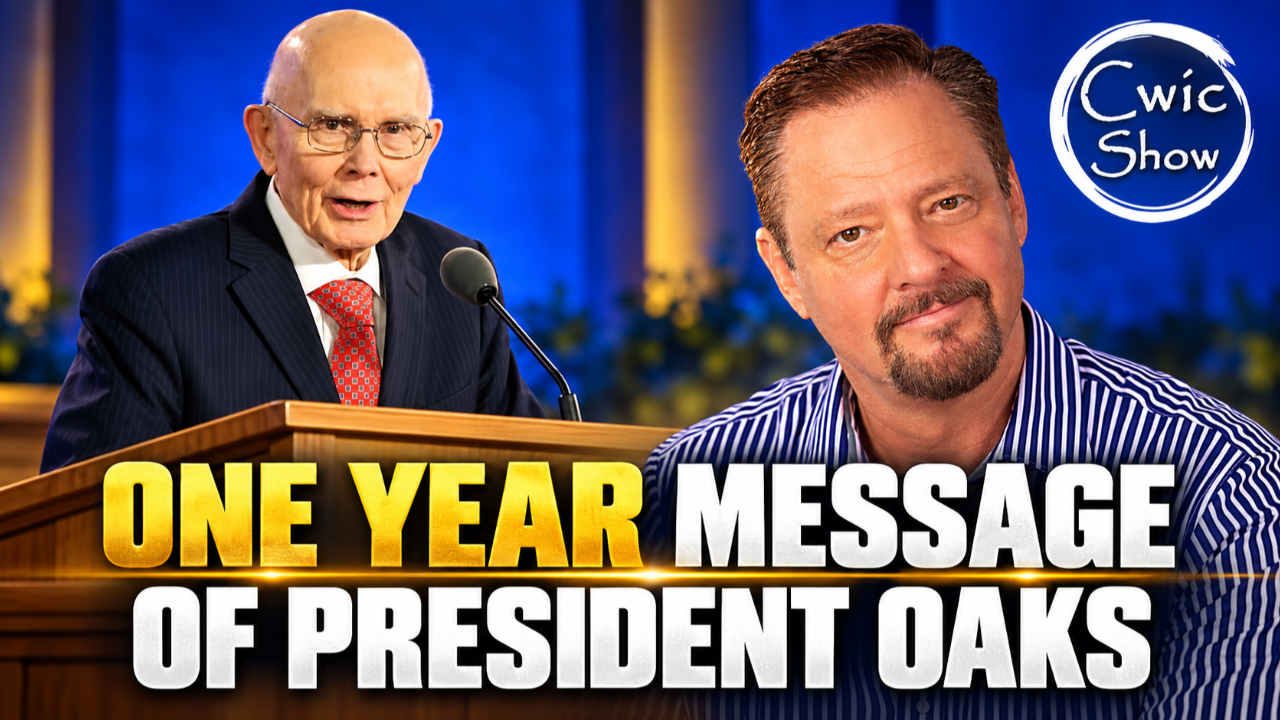
One Year as Prophet: What President Oaks Has Actually Been Teaching Four Messages That Define His First Year “Pray to the Lord”? Why President Oaks Keeps Drawing Godhead Lines He’s been saying the same four things How President Oaks is reclaiming what makes the Restoration distinct
Raw Transcript:
So, it has now been one year since President Oaks took over the mantle of prophet and president of the Church of Jesus Christ of Latter-day Saints. What
has his message been? He's accomplished several things. There's been a number of changes. I'll bring those things up, but what I really want to focus on here is
his messaging. I see four major topics that he covers. I want to go over each of those. The order of the family was
number one. That's been very specific for him. Jesus is the way with a qualification.
The uh that this is the one true church has been a a fantastic focus. And then lastly, peacemaking, which he continues on from President Nelson with a caveat.
So, we're going to go over each of those four and talk about this messaging that President Oaks has been given to the church in his first year as prophet and
president of the church. This episode is brought to you by going to Travel and the Gospel on the Nile tour. This is coming up in February and March. It's
February 16th to 26th, 2027 and March 2nd to 12th, [snorts] 2027. This is a
fantastic tour. I've gone over this with you before. It is a a a cruise down the
Nile and we go through several different temples and tombs, pyramids, things where we're going to see inscribed into
the walls of these temples something very very familiar to to you. I don't believe that you'll find out more learn
more about the temple anywhere else in the world outside of the temple itself than being in Egypt and going through these different sites. The education is
topnotch. The sites are incredibly well preserved and you'll have a new appreciation for the temple. You will
come back and your temple experience will be enrichened. It will it will it will be different, wonderfully
different, I believe. To find out more, go to quickdia.com, cwicdia.com. At the top, it's trips and events.
Scroll down to gospel on the Nile. Would love to see you there. Go to the pyramids with you. Take a camel ride with you. Amazing, amazing experience.
Here we go.
[music]
Chapter 2: The order of the family
So, welcome to Quick Show. My name is Greg Matson and I am your host. Be sure to subscribe and hit the bell for notifications for additional content
[music] from this channel. Okay, so President Oaks, I think he goes over four major topics in this first year of being president of the church. Remember,
he starts off in general conference in October 2025 with a talk. He still wasn't made president of the church yet. This is as
president of the quorum of the 12 before he's actually sustained as the president of the church but after of course
President Nelson passing away. Uh you remember we had that solemn assembly at that time but he starts off with this
talk above all things. This was his first talk in general conference and it
was the family centered gospel of Jesus Christ.
He wants to focus on this and he sees a lot of the data I'm sure that I see on this and we had done an episode on this before but he covers a couple different things on here that are very important.
First of all he states the church of Jesus Christ is sometimes known as a family centered church. It is. And if you recall he said that very
emphatically. Coming down here he says in the United States we are suffering from a deterioration in marriage and childbearing. It's interesting to me
because I've been covering this for years and even with positive uh faithful podcasters sometimes within the church,
they will push back on some of these things that I've been saying [snorts] about, you know, the birth rate and and about women falling away from the
church, young women especially falling away from the church. And there was all this feedback and and I'm like, why are you why is this coming up? I don't quite
understand this. Uh but here he is confirming the same thing right he's talking about for he says for nearly a
hundred years the proportion of households headed by married couples has declined and so has the birth rate and I
think sometimes people want to push be such yesmen and women for the church almost to propagandizing everything that
they're afraid to say anything negative and I don't think that does anybody a service at all because when you're
holding up things that are not true so that you can deliver something with rosecolored glasses and then people realize it's not true.
There's a bigger fall that happens with those individuals. There's a there's a a a cognitive dissonance. There's like, wait a minute, what?
So I I think that's really something we need to be focusing on online is making sure that we are trying to deliver the
truth about things and not just trying to to to Clorox everything and disinfect it
before we deliver everything. We should be giving truth through a faithful lens.
That doesn't mean that you have to be a yes man, yeswoman on everything here.
So, President Oaks is delivering the truth here as as president of the quorum of the 12 and he says for nearly a hundred years the proportion of house
households headed by married couples has declined and so has the birth rate. All right, very big issue in in not only the
church but in the west actually the entire world but especially the west.
The church does better than most but we are following in the same footsteps as as everybody else. Be aware of the problems. That's not being unfaithful.
Be aware of the problems. He says, "The marriages and birth rates of our church members are much more positive, but they
have also declined significantly. So, we're heading in the same direction as our culture, just we're doing a little bit better
job, right? that that's that's great to some degree, but there's a destiny that
both of those arrive at. And so, at some point, we need to turn that if possible.
He also states, "It is vital that Latter-day Saints do not lose their understanding of the purpose of marriage and the value of children.
That is the future for which we strive.
Exaltation is a family affair." He says that President Nelson has taught us this. Only through the saving ordinances of the gospel of Jesus Christ can
families be exalted. So putting our minds toward a goal of exaltation and a
an eternal family needs to be at I think our core that that is what we should be
focusing on. And when we are putting off marriage and we're putting off children
because of whatever the economy uh a woman's career or whatever it is, I I think we're really causing a disruption
in the order of the family and in order of of our progress.
And there is a very strong uh a very strong undercurrent
of of careerism for women over motherhood. It has been attacked from every single angle from from
philosophies of men from feminism to critical theory to Marxism to uh postmodernism to all of these things right to materialism.
It is a it is a real battle to overcome that. That doesn't mean that women can't
work. That doesn't mean that they shouldn't work. What it means is that they should be putting their family first, not their career. And I do
believe that in this uh especially Gen Z and beyond, I believe that we have moved
into a position where a lot of parents have said to their daughters as teenagers and as young adults, go get
your degree. Go establish yourself in a career before you ever start a family.
And and and in my mind, that is a massive massive mistake.
And the numbers bear that out. The fruit bears that out. The strongest marriages are are ones that happen early and where the where you have kids early.
And and and why pull away from that?
And if we're never going to change the the the the marriage numbers or the birth rates unless we change that concept.
And not that there should be shame in a woman going and having a career, but ideally we need to shoot for an
ideal. And the ideal is motherhood and family.
And we're to a point now where many of you are saying, "Well, Greg, that's misogynistic." That's where we've come to in our
perception of these gospel truths and this order of the family. But this is his first message. One more point here. He says
the national declines in marriage the national declines in marriage and child birthing childbearing are
understandable for historic reasons but latterday saint values and practices should improve not follow those trends.
Well, good luck.
that that is not going to happen until parents teach their daughters and their
sons that they need to get married early if possible to the right person. I'm not saying just go get married. It's a
horrible reply to me. It's not what I'm saying. But find a good girl, find a good guy that is dedicated to the
gospel, that is dedicated to that spouse, to that person, and to h building a family. And don't put it off,
right? If we don't change that, then then we're in trouble. At least in the West. Maybe the rest of the world will will make up for it and the day of the
Gentiles is is about over. That's a real possibility. Okay, so that's the first thing that he covered. Uh number two,
Chapter 3: Jesus Christ is the way
I know this also from other sources
[clears throat]
that one of his primary, if not his primary focus is on building a relationship and and following Jesus
Christ. Jesus is the way. So we can see several different things here. This is coming out from the church news. Uh this
just came out yesterday on things that President Nel uh President Oaks has done, right? So it starts off talks
about obviously his choosing his first c his counselors for the [clears throat] first presidency.
Uh he states here in his message on October 16th, so about a year ago, to
the journalist Jane Clayson Johnson when he was asked if there was one phrase or scripture he would want Latter-day Saints to carry with them as he begins
his prophetic ministry. His answer is Jesus Christ is the way.
Now, here's the issue, and we've seen this recently, and it's true. The church in many ways has been
giving this message about Jesus Christ almost in a way where um some members have been confused about
it being almost like this evangelical message like like what is the dressing around this? What is the distinction
between us and everybody else? And what I love about what President Oaks is doing is he's saying yes, Jesus is the way. And of course that's always been the top.
uh language has changed in the last 30 years, but he he's been very specific about the
godhead. And he's gone over this a couple of times. He went over this again in just his recent talk in the October
just just last week, right? The October conference where he talks about God the Father, you
the father of our spirits and Jesus Christ is the savior and then there's the Holy Ghost that these are three very
distinct beings and very different from the rest of Christianity that believes in a trinity or a triune God.
We believe in three very distinct beings. And that's really important.
When I was growing up and and this sounds weird, would it sounds weird to people now and maybe if you're my age or older, you'll remember this. We never rarely ever use the term God.
Think about that. And and if you were using the term God, it almost sounded like it was some creedle Christian
reference that they were making. We didn't use the term God unless we were reading from the scriptures where it would have said that.
Why? Well, because what we had been used to in uh up until about the '9s is 160
years of making sure that we are distinct from credle Christianity.
And so when we refer instead to God, we always referred to either God the Father
or Father in heaven or we referred to Jesus or Jehovah or
the Lord or the Savior and then we had the Holy Ghost, right?
But we always made that distinction. You did not talk about just God. And the reason is is because our language is
important to to articulate the concepts and truths of the gospel.
And and so we we instituted that separation very early on and continued on with that that vernacular.
And then sometime in the '9s to early 2000s, we started to change that. And maybe that was for the benefit of the rest of the world. and we started using
the term God a lot more. The problem with that term, I mean, the benefit, I'll follow up with that. The benefit is that people relate more to what we're
saying and you can just say God and they say God a lot and so God, right? You you have a an easier way to speak to others.
The problem with it is is that what do you really mean? Who are you really talking about? And I have seen this
confusion now happening over and over and over again because if I just say God, I'm not referring to an individual necessarily.
Now, typically, if you're saying the term God, you should be referring to the father. That's who you should be
referring to. But that should be distinct in your mind unless you're talking about something like Jesus is the god of this world.
Right? And you're you're g you're putting it into context.
God is the father and Jesus is his son. Jesus Christ is the Lord. So if you go through the Old
Testament, you see the term Lord C. When it's all capped in the King James version of the Bible, when that's all capped, that is Jehovah.
It's a reference to Jesus Christ/Jhovah.
And that was what oftenimes we call that the God of the Old Testament because of the way the Old Testament is written.
But we we we we mess that up a lot today because we don't make that distinction anymore. And and I'm kind of hitting
this a lot because there there is a lot of confusion on this. even from the church communications department. There
was very recently an email that went out and and giving solutions to I think it was
overcoming adversity. I can't remember what it was, but one of the one of the one of the solutions was to pray to the Lord.
No. And don't think that everything that comes out from the communications department or in an email is written by one of the brethren. It's not. They
would not write that. But see, there's confusion. You don't pray to the Lord.
The Lord is Jesus Christ.
You pray to God the Father. You pray to heavenly father.
The person we embrace at the veil is heavenly father. The veil between you is the mediator Jesus Christ.
The garment that is worn is putting on Christ. The garment is the same as the veil.
Right? So it's that's that's an important thing. So we have this Jesus is what does he say
here? Jesus Christ is the way. He says Jesus Christ is the way. But he always
not always but he he emphatically puts into place the distinctions between the father and the son and the holy ghost.
And we don't want to let that go. I think he sees that that that's been an issue and so he's been distinct about
that at least a couple of times publicly on the Godhead. Right? So I think that's a very important point. The third one
Chapter 4: The one true church
that he has gone over and he has done this a couple of different times. He did this in the recent general conference
uh address. He stated it and then he said it at the National Cathedral a few weeks ago. a couple weeks ago
where he stated that this is the one true church. Actually, he didn't say it at the cathedral. I'm trying to remember where he said it. He said it at another general conference, I believe, but he states this is the one true church.
He wants to be very specific because what's happening again when we don't get the the the
messaging from the top, then what takes over is culture. And our culture is very much into adopting inclusion, diversity,
right, and equity. And so we want to naturally move out into those areas. And you have some people that are very much
with that worldview. And so they push this.
And so you end up with, oh, we're all just Christians and we should look at it that way.
And that's that's a problem, right? It's a problem. Now, I'm not saying fully I believe that other Christians are
Christians unlike the way it usually comes to us, right, where we're not believed to be Christians. I believe that others are Christians regardless of
the fact of them being in the true church or not. They are Christians. They believe in Christ. They believe Christ as their savior. We believe in a very
different nature of God, a different nature of Christ.
But we believe in the New Testament, right? But it's not all the same. And and so President Oaks went through again
here in his last address talking about what are the differences. The differences are we have the restored truths in the one true church and we
have the restored authority. Nobody else has those. Nobody else has those. And that needs to be put in as a
distinction. So yes, Jesus is the way.
He is not the father. He's the way to the father and the true church. And it is the true
church. Read section one of the doctrine in covenants. It is the true church.
The popular way of saying this today is that well the church isn't true but the gospel is.
No sorry that's not the way it is. True doesn't mean perfect. True doesn't mean perfect.
It's the true church because it has the true principles, the tress, the fullness of the plan of salvation and the
fullness of the priesthood, right? It has the authority. That's why it's the true church. And so saying that
in a testimony is correct. It should be stated, I believe, in in a testimony.
Could be stated in a testimony. So he's been very emphatic about that in making sure that we understand that there is a distinction between the Church of Jesus
Christ of Latter-day Saints and our good Christian brothers and sisters
21 minutesthat share in that worship of of Christ and and and a belief in him being
our savior and redeemer. Okay. And then the fourth thing that he's gone over
Chapter 5: Peacemaking with truth
here that uh is a continued message from from President Nelson is peacemaking.
But there is a caveat to this and he's gone over this at a little bit more of a a little bit more nuanced than what
President Nelson had done. And you hear some of this like from Elder Renland and and others where there are some caveats to the peacemaking. You do not surrender truth.
That's not part of peacemaking. You don't need to surrender truth. You should never surrender truth. Uh the contention part is something that is a
desire or do you have a desire to create contention? And of course in in the recent talk I'm trying to remember who
gave this was it Elder Gilbert I believe who talked about being a peacemaker. He actually used the term I think standing for truth with charity or with love.
standing I think wasn't it I'm trying to remember standing for truth with charity or standing with tr for truth with love
and that's the right approach and so he's using the look at his language there he's saying stand for
truth with love because otherwise if you just talk about be a peacemaker that becomes nebulous and misunderstood
sometimes so he's saying he's talking about being a peacemaker he is talking Elder Gilbert's talking about being a peacemaker, but he's he's
comes out stand for truth with love and so that message has continued. Now, you see a caveat there
also from, you know, where he he's done this a couple of times. He had a talk a few years back
at the University of V Virginia, I believe it was, where he really went over this idea of fairness for all. He's talking about religious liberty. It's under the umbrella of religious liberty.
Um, it's not something I believe works in every case. I I think it can work in some cases, but I don't think it works in every case. Um, standing for truth
and being a peacemaker and having fairness for all, those are going to come into conflict sometimes.
But I think it's interesting that the night he talked again about being a peacemaker
and fairness for all in working through things through the Constitution, which is all true.
13 colonies trying to get what their what is theirs, so to speak, to start the Union off, had to
give up some things in in allowing others to have their beliefs and others and etc. and and and joining in and of course then you have
the civil war where there's a separation again so but again going to the civil war I mean
that's a great example is the north going to look for fairness for all in the sense of the plantation owners
how far do you compromise on that right there was a line where the north was not going to compromise
so and then Of course, there's a line where the church is not going to compromise with abortion
because the very next day at night in the evening where fairness for all is given by President Oaks, the next morning the area presidency over Idaho
sends that letter off to the state presidents and bishops um talking about supporting or not
supporting Prop One or is it supporting Prop One? not supporting Prop One. And so, you know, that was very strong. It
was a very strong. It's like, no, this is our line. We're not looking to compromise on this. And then, of course, since then, they've given a million dollars to
support the effort, the political effort in in fighting that. So, I think that again, I I think we're going to get more
and more nuance on this idea of peacekeeping. And I think that peacekeeping is the right thing if it is qualified and defined
and and I think that's where they're going with this. They're going to continue to define what this means and what needs to be done. So those four
things, the order of the family, Jesus is the way with a distinction in the Godhead,
the one true church while we can still build bridges and love those around us. and then
peacemaking with the caveat of standing for truth with love. I think those are the things that that President Oaks has
been those are his four major messages and I think we're going to continue to see more of those four messages [music] in his ministry as president of the church. Thanks for listening.

"I Take This Every Day!"
Learn more about why I accepted Cardio Miracle as a sponsor and why I take it every day!
- Greg Matsen

Stay Connected With New Articles & All Things Cwic!

Cwic Audio Player
All of the Cwic Media podcast episodes on one page!

