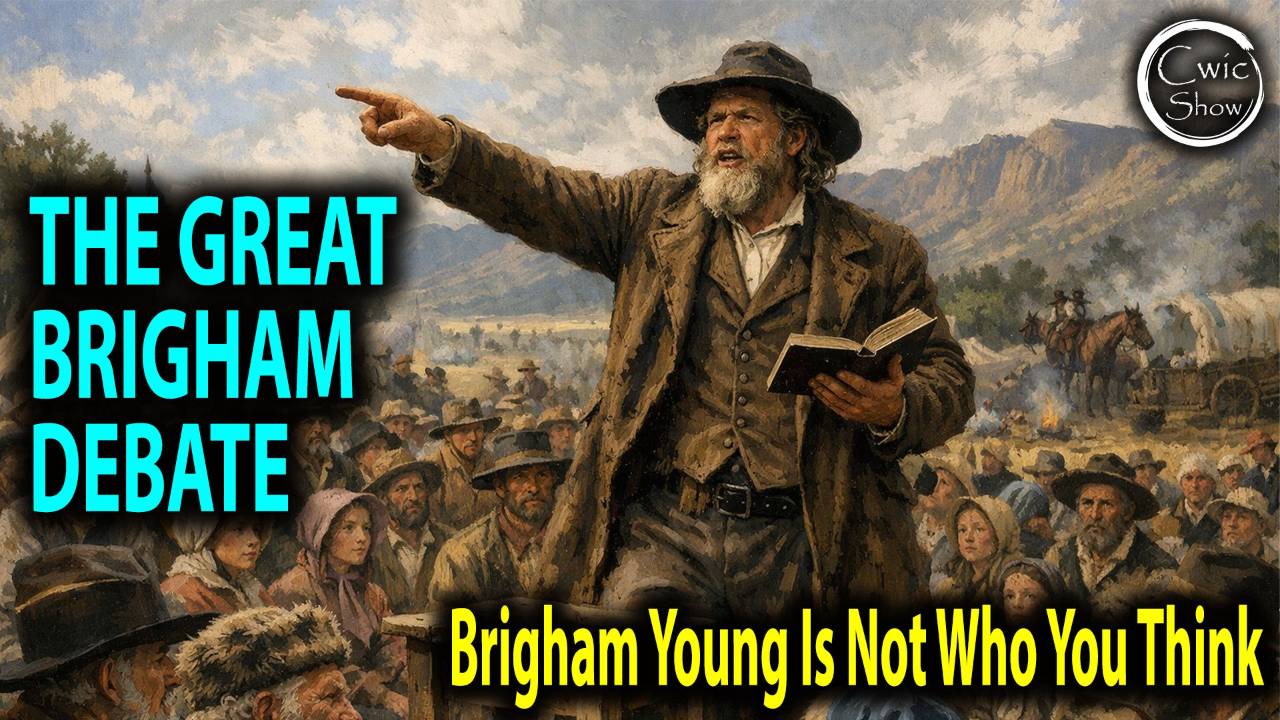
Brigham Young, a lightning rod, the new lightning rod. It has always been Joseph Smith in the past, right? Everyone will
be talking about Joseph Smith. We've heard these words many, many times. It's usually where the arguments and the
critiques of the church come down to in church history. But in the last year or
two, maybe few years, we've kind of moved a little bit from all of that onus being on Joseph Smith over now to
Brigham Young. I think a lot of these things have been solved and talked out with Joseph Smith. still controversy
there. But now Brigham Young seems to be at the center of all these things. His character, number one, number two,
polygamy, and number three, the temple. And what's so odd is that these are the
exact same arguments that were brought up during the succession after Joseph
Smith's martyr. In other words, those that did not want to go with Brigham Y. Young, those three things are exactly
what they talked about. It's the exact same arguments, the same references.
It's like we're living in the 1850s and 1860s
again. So, I invited Dr. Daniel Peterson, one of the greatest apologists of the church ever, and who has just
launched a new documentary series on Brigham Young called Becoming Brighgam
to talk to him about Brigham Young's character about polygamy, about the temple, and why we might be focusing on
these things so much. Now, if you've had questions about Brigham Y Young, you're going to love this interview. And make
sure that you watch Becoming Brighgam. We'll put the link to the YouTube channel for this series in the
description box. Go to it after you watch the video. This episode is brought to you by Go and Do Travel and Gospel on
the Now. I want you to come with me to Egypt. Our next available trip is
October 27th through November 6th. We're going to go through numerous temples, the pyramids, a camel ride, tombs,
mummies, and a cruise down the Nile. The next available trip is October 27th
through November 6th. You will leave Egypt having a complete story that you will never forget and that you will be
able to repeat to everyone around you. The gospel is on the Nile.
Go to quickdia.com. That's cwicdia.com. Go up to the top to trips and events and scroll down to Gospel on the Nile. I
will see you there this fall. Here we go with Dr. Peterson.
Right. Welcome to Quick Show. My name is Greg Matson and I am your host. In this episode, we bring on Professor Dan
Peterson. Dan, how are you doing? I'm doing well. Thank you for having me. Good. Thanks so much for coming on the show. You know, Joseph Smith has always
been kind of a lightning rod, right? We seem to be moving or gravitating now
more a little more toward Brigham Young as this lightning rod in in the online spaces here discussing the Brighgammites
and others, etc. What was the character of Brigham Y
Young? Well, you know, I've had some people tell me recently, even members of the church, that, you know, Brigham
wasn't really God's choice to lead the church. He kind of usurped the position, but but God can work through evil men.
And I bristle at that. I bristle at that. This was a good man. And I I don't even want to say he was a he was a
flawed man because everybody is. That's trivial. Um when people say, "Oh, Brigham Young was a flawed human being."
I think what they're often trying to say is he was uniquely flawed or especially flawed. I'm not willing to grant that.
This was a good man. Did he have rough edges? Sure. He was a frontiersman of the early 19th century and uh and he
could be plain spoken, rough spoken. He he wasn't well educated. He wasn't smoothed by, you know, attending Harvard
Divinity School or anything like that. U and he himself would admit that that the toughest member he had to control was
his tongue. Um but uh but he was a good man. He was a sincere man. A man who was devoted to
doing the will of God. And and one of the things that I think is most spectacular about him is his devotion to
carrying out what he thought were the teachings of Joseph Smith. Absolutely loyal to Joseph in life and in death.
And uh and so this is a good man. I've interviewed for a project that we've
been working on uh Legene Kut for example and a number of other historians. Uh, Legene is the one who's
decoded or reads the the Pitman Shortorthand, 19th century Pitman Shortorthand. And she says, you know,
a lot of people know a lot about Brigham Y. Young. I know Brigham Y. Young and I've spent my time decoding his words
from these transcripts. And she says, what I see is a kind man, a gentle man, a sincere man, not not the kind of
monster that some people have conjured up. Yeah. The caricature that that seems to be profiled and and held up. How How is
it that we've gotten to our presentism right now in this in this view? Because
even good members of the church look back Yeah. and they're hearing the little tidbits, especially online, about about these
rough edges that seem to be very rough to them. Yeah. Context or no context. H
how is our current view of things been skewed so much? Well, one thing I think is he left so
much behind in the journal of discourses. There are scores and scores and scores of discourses to to cull from
and if you cherrypick you can make them look really bad. Sometimes it's out of context. But there's even a problem with
the journal of discourses itself. Leene Kuth whom I just mentioned uh I asked her once so what's the biggest
misrepresentation of Brigham Young and she said the journal of discourses. I said what do you mean by that?
That's interesting. She said well George D. Watt when she goes back to vi revisit George Watt's
transcripts his his um his Pitman shortorthhand she says when he would translate it back into English he
systematically made Brigham Y Brigham Y Young look more authoritarian harsher
more self-centered in a way than he really was. She said I don't know why he did that he was faithful but that seemed
to appeal to him or something. Um but she said it's not the real Brigham Young and she gives examples uh of that that
where you can see where it could go either way but but one way the transcript can be read and is a much milder way and and he always goes for
the rougher option. So that provides a lot of material and he was the governor of Utah territory for years and you know
and dominated the church for longer than any other president of the church and and so um he he left a lot behind and
there are a lot of ways and a lot of tough decisions he had to make a lot of things that can be interpreted negatively.
Well tough decisions. I mean you talk about being rough around the edges but that might have been again exactly what
the Lord needed to get done what had to be done. I kind of think so. You know, I'm not
sure when I think about it. Could Joseph Smith have done this? Yeah. Done what Brigham Young did? I don't know. But, you know, Joseph was the one
and Brigham laughed about it that Joseph was a terrible shopkeeper because he gave everything away. People
would come in and, oh, brother Joseph, I need this, but I don't have any money. Joseph would give it to them. And uh and
Brigham wouldn't do that. He said, "No, no, you got to make your ends meet. You
got to do the work." And and so on. He was a little tougher in that regard.
which again is needed. I mean, you almost do need in some cases in in, you know, you're talking about a frontiersman, you're talking about
somebody that's going to then, you know, lead a modern-day exodus,
you almost need to be able to take so much more on yourself. Yeah. And make your own decision.
Yeah. To get things done. One of the one of the flaws, there's a the 1940 movie Brigham Y. Young or
Brigham Young, I've seen it. Frontiersman, I think it's called. Yeah. It was kind of a nice thing. I mean, the
first really positive treatment that we ever got from any of the elite media really, if you will, and Dean Jag plays
Brigham Young, and it's very sympathetically. But one of the flaws that I would see with it, and one of the flaws that some
people have pointed out over the years is it depicts Brigham as being uncertain, that he didn't know, am I really the one
who's supposed to lead? Oh, what should I do? What should I do? That was not Brigham Y. Young. Brigham was confident
that he was where the Lord wanted him to be. And it's a little bit like the movie umh Darkest Hour. Historians that I saw
who critiqued that movie said they really liked it. It's great film. I remember walking out and thinking, okay,
forget about the voting for best actor. This guy just won it, which he did. Um but when when when
Churchill is debating should I do this, he goes on the subway and asking the common man, what should I do? That was
not Churchill. Churchill if one thing he knew was that he was raised up to combat Hitler
and he knew what he was going to do and he was not going to back away no matter who was opposed to him. Brigham Young and Winston Churchill in some ways
similar in that regard. I think Brigham knew that he was doing what the Lord wanted and what Joseph had wanted and he
did not waver. Do you you know speaking of these things and and his attitude, his courage, his
confidence, how would you describe his understanding
of prophetic authority? Then I don't think that he ever saw himself
as rivaling Joseph. He didn't want to. He had Joseph on a pedestal. He did. Um
but he wasn't shy about claiming revelation either. And he's a little more subtle about it. He almost never
says thus sayeth the Lord. He doesn't even use the term revelation, but he'll say things like this is what the Lord
told me. I inquired of the Lord and he said to me, so particular questions,
should we stay and finish the temple? He asked the Lord and the Lord told him yes. Um and he'll mention that kind of
thing on multiple occasions. So he was not he was not shy about claiming to be
in contact with the Lord. He says we have the oracles. we we know how to get the mind of the Lord. Uh but he didn't
want to try to put himself in Joseph's position. He didn't see himself as holding that that slot in a way. I mean
now three years after Joseph's death, he does become the president of the church. There's no question about that. Uh but
he always sees Joseph as the prophet and I am I am the president of the church.
I get the mind and will of the Lord. I'm doing what Joseph wanted done. We're carrying out the program. But he never
wants to arrogate to himself that that kind of position that he saw uniquely as
Joseph's. How did that how did those few years work in between the the the martyrdom of
Joseph and and Brum actually becoming the president? Well, you know, we've had occasion to think about this just recently with the
death of President Nelson. And some people ask, well, will President Oaks become the president of
the church? My answer was he was president of the church the second President Nelson died. It's just that he's present in a
different quorum. There isn't a first presidency but there's the quorum of the 12 and he's the president of that and the quorum of the 12 leads the church.
So Brigham Y Young effectively was the president of the church from 1844 on the first presence and he's not reorganized
for another 3 years or so. U but um but he was the president of the church and
it worked that way. Now he he worked with his brethren in the quorum and the quorum was a bit unstable. It it had
been early on and then they kind of got it stable. Then with the death of Joseph and Hyram, it you lose some members.
They go off in different directions. Uh on the whole though, the 12 hold together and it's really the members of
the 12 who'd served the mission in England who that forged a bond between them.
That's what put an end to the instability of the quorum. I think those who didn't go on the whole didn't stay
faithful. Those who did were were bonded together in a way that they never really lost thereafter. And I I think that's
fascinating. I think that's one of the things that made Brigham what he was and the 12 was leading the church in
England. When they're so far away from Joseph, they can't just write to him and say, "Hey, what do you want us to do?"
They're on their own. It's thousands of miles away in a time of bad communications. And so um so Brigham has
already led the church in a way in England and he's had experiences prior
to that you know leading the immigration out of Missouri to Illinois when Joseph and Hyram and Sydney are in in uh
Liberty jail. So I don't know that he recognized it at the time but he was being trained so was he Kimble so are
other members of the quorum to take over the leadership when Joseph died and they
did almost immediately. What were the arguments for those that would go with Brigham and those that wouldn't? I mean,
you had other leaders such as Sydney and others that were the Strangites eventually that right that that break off. I is
is it more of a cult personality at that point or is it obviously you want you want to believe that those that
follow Brighgam or well they they they felt that he was the right guy, he was the prophet, he would be the prophet and
how much did polygamy play in that decision? Oh, I think it played a role. There were people
I interviewed Ron Esplan a few months ago. Ron is the authority on the uh the transfer of authority and the uh the the
conflict over the succession in 1844. And Ron's point is look if you wanted to
follow the program of Joseph Smith then really the only the only game in town
was the quorum of the 12 led by Brigham Young. Everybody else, every other rival claimant wanted to jettison some part or
other of Joseph's program. Sydney didn't want to go to the west.
Sydney wasn't all that thrilled about the temple. Well, the two core elements of Joseph's program were finish the
temple and then somewhat contradically abandon it and go west. And the 12 said that's what we're going
to do. Um, Sydney didn't want to do that. But Sydney had had an argument. I
mean, they'd never had the death of a president of the church before. So now you have Joseph and Hyram gone uh and uh
and you have Sydney remaining member of the first presidency. Does he as a
member of the first presidency continue maybe reorganize it? Mhm. Well, now we know that that's not how it
works. You know, the first presidency collapses into the 12 and then it's reorganized. But they didn't know that
then. They had no precedent to go by. But I think one of the crucial things is that Sydney has been well a he's been
kind of absent from church leadership for a while. He's even back in Pittsburgh for one reason or or another.
Uh but for another he's not really meeting with the first presidency. He doesn't get his endowment for about two
years after Brighgam and uh and the others do. Um he doesn't seem to get the
priesthood keys. So if you want the church we have now with temples, eternal
marriage, keys of authority and so on, you can't go with Sydney. He doesn't have them.
Um and uh does he hold any keys to the temple at all as far as not really apparently.
Yeah. No. So and he doesn't seem to have been all that thrilled about the idea of the temple or or eternal marriage or
anything like that where Brigham and the 12 really are. They're committed to this. And the
others, James Strang claims a revelation. I'm sorry. There are a few strangites
out there, but I'm going to have to say I think it's transparently bogus that his claim is is just not true. Um, and
you know, I have Lyman White who heads down to Texas and so on, but the bulk of the 12 know what's going on and they
stay loyal to the program. It's not just loyalty to Brigham Young. It's loyalty to what they all understand as the
mission. the the program of Joseph Smith put in place. Did the Council of the 50 have anything to do with this?
Not a whole lot. Uh a little bit and their role is only now beginning to emerge out of, you know, murky history,
but you know, a little bit. And they certainly planned the uh the immigration westward to a large extent. Um but no, I
think it was the 12 really more than anything else, but of course they were overlapping sets. So uh it it's a really
interesting complex thing. The the most um uh the best treatment of this whole
thing I think is is an article by Ron Esplan who wrote one years ago and he updated it recently in a volume that we
actually published at the interpretive foundation called Joseph Smith a life lived in crescendo
and he Ron has a long article which I think is the definitive statement on the
succession crisis in 1844. He has read everything and thought it through for decades. It's just really a superb piece
of work that I recommend to anybody. So, let's get into a few of these things specifically that uh Brigham Young is at
the head of and in the middle of and that are controversial today. Yeah.
Um tell me about the priesthood ban. How does this come about?
uh Joseph Smith is is uh ordaining black members to the priesthood. Um then all
of a sudden we're not. There are members of the church that even head west that are black. Uh
where does the ban come from and how does it eventually unravel? We don't really know. I I just have to
say if if there's a clear smoking gun out there. I haven't seen it. We know that Brigham at one point is actually
praising a black elder as one of the best elders in the church. This is after the death of Joseph. And then all of a sudden at a certain
point he just says no, they shouldn't be ordained. Now where's that come from? Uh I think it may have something to do
with the disdain or the dislike that he had which was common at that period
of intermarriage, racial uh intermarriage between blacks and whites.
He didn't want to see that. So, you know, barring blacks from the priesthood, and there weren't that many
in the church at that time, uh, would sort of take care of that issue. They couldn't go into the temple and get
married there. I don't know. I'm mind readading here. I'm guessing. I don't know because it's it's sudden. You see
it and suddenly he goes from one position to another and he says that he
got it from Joseph. It's not clear how he did. Joseph was ordaining blacks. Brigham. Young had no objection to
ordaining blacks for a while. And and But there's something else I'd like to
say about that if I can. Um there's a book that came out what about a year or two ago called this abominable
slavery by uh Paul Reeve and Christopher Rich and Leine Kuth again which is about
uh about slavery in the Utah territory. To me that looked like a really technical book that you know maybe would
be of interest as a footnote to to some issues in Utah history but not that big a deal. When I read it I thought this is
absolutely spectacular. This changes my view on some things I thought I understood. Um, I had learned that Bighgam had
supported a bill in 1852 that legalized slavery in Utah territory. And I thought
that's embarrassing. That's, you know, not one of his finest hours. Well, reading the book, I realized very
quickly that is not true. That's not what he did. This bill in 1852 did not legalize
slavery. It legalized a form of servitude, which is different. Indentured servitude was an accepted
idea in the United States prior to 1860, prior to the civil war. Brigham Young
himself had served that way. A lot of the leadership of the church had they saw nothing wrong with indentured
servitude. You lose learn skill. It's for a fixed time. This bill was an attempt at what uh what the book calls
uh gradual emancipation. Uh and the idea is that yes, people who are enslaved now
will be servants, but that will end with their deaths. Their children will not inherit that
status. That's going to put an end to slavery. They have rights. They can appeal against bad treatment. They are
they are expected to receive a certain number of months of education per year. Probably, I'm guessing, not that much
different than the average white person got in 19th century frontier America. They had to be taught to read and write.
They they had all sorts of rights that they didn't have under chatt slavery. And Brigham Young goes out of his way to
say that he hates chatt slavery. It is not right to own human flesh, he says.
And so that puts the priesthood ban in a different light. He didn't see them as inherently slaves.
He did see a kind of secondass status for them. But I I gave a speech based on this book at the fair symposium or fair
conference back in August of 2025. And I I tried a little cutesy thing at the
beginning. I said, "Look, I will admit, I frankly admit Brigham Young. Young said things about racial issues that
make me cringe and just everybody else will kind of squirm them uncomfortably. So, I'm going
to read you a lengthy statement." And and I did. I read one about how blacks have secondass status. Da da da. They
should not rule over whites. And you know, and then I said, "But by the way, that's not Brigham. Young, that's
Abraham Lincoln." M and and so you've got to put him in his time. Uh and and did he hate blacks? No.
This book actually, the subonal slavery by by Reeve and and so on, uh actually
has several stories in it that to me are really interesting about uh about his
treatment of individual black people. He apparently bought several slaves, freed them, and set them up with property to
farm. And at one point, I think it's Green Flake, who comes to him and says, "You know, I'm still having to pay off
my wife's uh servitude." And Brigham says, "Stop paying. You don't owe them a
thing. You're free." Um, and then and just before I stood up to speak, Mark
Ashist McGee was sitting next to me. He was a Latter Day Saints historian. He says, "Dan, do you know this story?" And
he told me a story that I thought was fascinating. And I included it in my remarks. I mean, um, it's it's about,
uh, Elizabeth Kaine, Thomas Kane's wife. Thomas Kaine was the friend of the Latter-day Saints, not a member of the
church as far as we know. Uh, I have friends who claim no, no, no, he was baptized secretly. Maybe he was, I don't
know, but he outwardly was a non-member. And he was an abolitionist. His wife had a little more traditional
uh, attitudes. And so at one point she's uh she's disgusted to see that a black
slave is traveling or a black man is traveling with uh with Brigham Y. Young to southern Utah and he has really bad
rheumatism and joint pain. And so they put cushions in one of the wagons and
allow him to to ride reclining for the rest of the trip. And then she's really horrified when she comes around a corner
and she sees that man who can't move his arms very well. And there she said, "I saw Brigham Young. Young, the pontiff of
the Mormons, helping a black man on with his coat." She was horrified by that. That was
just, you know, something that shouldn't happen. Those sorts of stories put Brigham Y. Young in a totally different light to my mind.
Sure. The priesthood thing is strange. I don't quite understand it. But was he was he a racist? Yes. Did he hate black people?
No. Well, what do you mean by racist then? I mean, what what is the definition on the basis of race?
Okay. which that and we see every kind of distinction on the basis of race as
racist on one level it is I suppose but it's not always hateful
and uh and there are lots of instances of Brigham Young treating black people kindly you know rebuking people who are
mistreating a black man who was probably mentally ill and they treated him as subhuman and he says he is a son of God
he is a son of Adam and Eve he should be treated with dignity that's not the Brigham Y. Young that
we've been led to believe in. Well, those aren't the stories we hear. No. No. And and unfortunately, even within the
church, you know, we don't get a whole lot of that. I think that Brigham Young is right now, personally, just my
opinion, just from what I see, it it seems to me that even within the church, he's kind of sliding down this
uh this path of of we'll just we'll just have to deal with him. Yeah. Yeah. you know, he's part of our
history, but and we're embarrassed, but you don't have to be embarrassed. Again, was he a
flawed man? Yes. So was Abraham Lincoln and in some of the same ways. And uh and so but does Brighgam have a
lot of good qualities? Vast number of them. And it's it's not a surprise, I think, that the the saints who knew him
tended to call him Brother Bighgam. He was he could be rough. But one of the
things that we're hoping to do in this project I'm working on is to interview a couple of historians up at the church
history department who are compiling a collection of Brigham's letters to ordinary saints.
And I've been told, I haven't seen the manuscript yet, but I've been told that you're going to see a different side of Brigham here. This is could he be rough
from the pulpit? Yes. But what about the pastoral Brigham Y Young? The Brigham Young who has some struggling saint in
his office. He really tries to help and he writes kindly letters to them. And uh
this again is not a side of him that's been emphasized. We've kind of liked the stern taskmaster, but there's that other
side of him that that should not be lost. Um and so I'm hoping to make that
more evident to people. Uh there is a growing group of
Latter-day Saints that uh have been given the term the label polygamy
deniers. It's not that they deny polygamy. It's that they deny that Joseph Smith ever practiced it or that
he even uh had any uh ceilings, you know, of any other women besides Emma to
him. Um and it's a very it's fascinating to me because I I've I've sat down with a
number of those that are the biggest voices, you know, face to face like you and I are right now. Yeah. and and discussed this with them.
Um and and looked at the evidence and and
you know, I try to keep a pretty open mind about things and and so I'm looking at like, okay, yeah, that's really interesting and that's interesting and
yeah, I could see how you could come to that conclusion. And what we're getting right now, I think, Dan, is you've got,
you know, you've got the the book the the Saints series, right? And then you've got the Joseph Smith papers. So
you've got what has usually been held just within academia that is now wide open for the entire
world. Yeah. Right. And so people are trying starting to grab some of this which is great. It's marvelous. It's
wonderful. However, anytime you have that kind of a change, you're going to go through some growing pains.
Yeah. And and so a number of individuals have gone through and picked facts out. their
facts and started to put together a narrative from these facts being that
Joseph never practiced this and that Bighgam and Hebrew C. Kimell especially
and then their close inner circle are the ones that came up with polygamy and
uh to the point that even a group of them say that Brigham Young was responsible
for actually the assassinating Joseph Smith. Yeah. that he he deployed John Taylor and Willard Richards to do it, which is
mad. It's unreal. But but there's a whole spectrum, right? It's all the way from these are faithful Latter-day Saints to
to the assassins, right? And and here's the problem I have. One of one of the problems I have with it. Number one, I I
don't I don't the evidence to me is not enough evidence. But secondarily,
there is to me, and even though they'll argue against this, there is no way to go through a process of succession,
prophetic succession, without completely undermining Brigham
Young and and John Taylor and Lorenzel Snow, Wilfrid Woodruff, and Joseph F. Smith. Yeah. and saying these were not just
flawed men, but but these were carnal men that put this above their will for
God and to the point of lying about scripture and lying to an
entire people. Yeah. That Joseph Smith believed this but when
in reality he didn't. Now to me it's a clear path to apostasy. The logical outcome of
which we've already seen some of those results. Yeah, we have. And I think, okay, are you comfortable sawing off the branch on
what you said because that's what you're doing. So, you know, but but you could say, well, that's an argument from the
bad consequences, which is true. Has really bad consequences from my point of
view. Fortunately, the facts don't demand that kind of a rewrite of history. I think they go very strongly
against him. How many people have to be in this conspiracy? all the women who testify, the leaders of the church,
members of the quorum of the 12, men who gave everything for the kingdom, and they lie about this. And and one of the
points that that I've seen in studying Brigham Y Young for this project we're currently involved in, a a a series of
many documentaries that we're calling Becoming Brighgam. I spent a lot of time with Brigham Young and with his story.
One of the things that emerges, I already knew it, but it really emerges clearly, is Bighgam was absolutely
dedicated to doing what Joseph Smith wanted. That is maybe the lead characteristic of his ecclesiastical
life, if you will. Um, and you see it, we did a film a year or two ago called
Six Days in August. And there's a scene in that film where and this is a true story of course where uh several members
of the quorum go back into Missouri under the extermination order and lay the cornerstone for the temple at far
west. And the question is why? I mean the temple's not going to be built now. And why are you doing this? Well, because
Joseph prophesied that it would happen and so we're going to make it happen. And they're going to England. They're
going the wrong direction. They go to far west then they have to backtrack and go to England. Why? Uh I would have
thought you could say well look that prophecy was given when we were in Missouri it made sense then it you know it doesn't make sense now but for
Brigham Young Joseph said we're going to do it and we are going to do it even if it risks our lives we're going to go lay
that cornerstone on this date because Joseph said it now that is emblematic I think of of Brigham's approach to life
and uh you know there there is a famous incident where Joseph rebukes Brighgam over something and everyone kind of
holds their breath breath. You know, Brigham is the lion of the Lord, right? He's already got that reputation. And
this is a man who does not bend the knee lightly for anyone. So, how's he going to react to being sort of called on the
carpet by Joseph? They're astonished when he responds, "Joseph, what would you have me do?" I'm
not sure Brighgam would have done that for anybody else. But the idea that Bighgam would have deliberately gone
against the teaching of Joseph Smith on a question like marital morality uh let alone raised his arm against the
prophet and orchestrated his assassination. This is madness. It's in it's incompatible with the man that we
see in history. It's just not there. One of the reports says that when when Brigham died, his dying words were,
"Joseph, Joseph, Joseph." I wouldn't be surprised if Joseph came for him. Mhm. Brigham dreamed of Joseph. He had
postmortem. I think in the movie you were talking about he does, doesn't he? In 194 the 1940 movie.
I think he does. I think he does come back. Yeah. Yeah. And I wouldn't be surprised. Yeah.
Brighgam was absolutely loyal to Joseph. And this idea that he invented plural
marriage uh and foisted it on the church and lied about it for decades. There's no evidence for it and there is
a scad of evidence against it. I just find that absolute lunacy. I'm sorry. I I don't have much patience for it. We
actually published something with interpreter a while ago that to me deals a serious blow to this. I mean, you can
argue about what Joseph said. It's pretty clear Joseph, if he was practicing plural marriage, was lying to some extent when he said he wasn't. Now,
you could say that's a prudent lie. You know, does this dress make me look fat? There are times when the truth is not
the best policy even though it's kind of awkward to lie and and best avoided. But
um but in uh uh oh my now I've forgotten
where I was going to go with that. I was going to say well the article. Yeah. Oh yes I was going to talk to you about the article uh stream of
consciousness up here and sometimes the consciousness fails. Uh but um we
published an article written by four co-authors uh Paul Fields, see if I can
remember them, Steve Densley, Matt Roer, and and Larry Basist. Um which is a
historical analysis of section uh 132. Now, even if you have statements from
Joseph about plural plural marriage where he says we're not doing it, if section 132 is from Joseph, then Joseph
is absolutely solidly associated with the idea of plural marriage. And so what
they did, uh, Paul Fields and Larry Basista are are statistitians. They applied what's called wordprint analysis
to section 132. And I won't summarize the evidence as technical, but they lay it out very clearly with charts and
graphs and statistics and everything else shows that section 132 almost certainly comes from Joseph Smith
through Joseph Smith. The closest thing that it pairs with his early 1830 revelations in the Doctrine of
Covenants. It does not match anybody else who's been proposed as an author, William Clayton or Brigham Young or John
Taylor or someone like that. And there's also historical evidence that the revelation was being discussed, talked
about in contemporary sources, sources that that predate the death of Joseph.
It's already there. High council meeting and others. Yes. And including from people who didn't like it. They got really angry about it,
others who supported it. Um the evidence for that coming from Joseph is overwhelmingly strong. To me,
that just does in the case that Joseph wasn't associated with plural marriage. Yeah, I understand why people are upset
about that. Plural marriage is an awkward topic. Yeah, it's obviously difficult for half the church.
Um and more than half the church probably, but but uh I can see why people are uncomfortable or why some
would want to say, "Well, it didn't really happen or it wasn't really Joseph. We want to preserve the purity
of Joseph and so on, so we'll blame Brigham Young. Throw Brigham under the bus. We don't care about him." But you
can't do it historically. It can't be sustained. Yeah. And that 132, section 132 is the
cog, right? I mean, that is you you cannot, you have to do something with 132
if you say that Joseph Smith never never practiced it, never wanted it, etc. So again,
you're going to a point where you're saying that Brigham Young wrote it and
made it up. Yeah. And said that and said that Joseph Smith wrote it. Yeah.
And that's the type of person that was leading the church. He's a flagrant liar. It's unbelievable.
I mean, it's now they'll come back and they'll say, "Well, well, did Joseph lie or did Brigham lie?" Right. And and it's like, well, okay, uh,
Joseph did. Yeah. So, he did, but you know, there are times he's trying to avoid. I mean, Nauvoo is
a tinder box. Mhm. And, uh, you got disscent within the church. You got horrible enemies outside
the church. And, uh, and he doesn't want to throw any anything on the fire. Well, it might undo the church.
Yeah. Absolutely. completely. And so he, you know, the evidence is and and I've heard some people say, "Yeah,
right. He resisted it. He was all too eager." The ones who believe that Joseph invented plural marriage. No, I think
Joseph realized this was an explosive issue in it. It's not our permissive, sexually permissive and promiscuous
time. It's early 19th century America and you're propounding a wildly unamerican,
you know, immoral, uncchristian idea of marriage. This is not going to going to help the church out a lot. And so Joseph
is trying to avoid going forward with it. He's unenthusiastic about it at first. He's kind of pushed into it and
then he tries to keep it a secret. He doesn't know when he's going to talk about it. I understand it. I understand
the desire to keep it quiet. You know, again, I think there's this
this odd thing that's happened where there's been so much talk, you know,
about Joseph Smith, but maybe we've gotten to a point where there's been
enough defense of Joseph Smith that it's not just unless you're very much on the
outskirts and you've never really done much more than than regurgitate, you
know, certain certain anti- Mormon lines or or uh uh critical lines. of of Joseph Smith. But it's it's almost like, okay,
well then then then let's go to Brigham Young. Yeah. And let's get Brigham Young on this. And and I was reading I was going back and
reading a uh and now I'm going to forget the name of it, but I was reading a
the publication of what became the the RLDS church. So
there's a a group of men that are together. They are against all the brigamites,
right? And they are looking at what they're going to do. They want to form a church. They want to get Joseph Smith III
involved, but he's not yet. And uh so this is like in the late 50s,
1850s, and they have this publication that goes out that they send out and that that it was
a it was a monthly or quarterly publication they put out. And I go back and I find it and I'm reading it and I'm
looking at these lines of what these men are saying. It is exactly the same thing
that is being said today against Brigham Young and against polygamy and even the temple.
Yeah. Right. That that we're starting to hear today again. It's like we've made this cycle of what you know uh 160 years 165
years later that where we're back at the same point. And I think that for someone who is looking at,
well, do I just not believe that Brigham Young was a good man and a good character and a man of God, what would I
have done in in in the time period just after the martyrdom of Joseph Smith if I
was a member of the church then? Yeah. Would I have been against the Brighammites? Would I have gone off with
one of the other factions? What would I have done? Because based on the arguments of some members of the church,
I don't see how you would ever follow Brigham. Young in in that case. No, no. They've they've conjured up a
kind of monster, you know, this this lustful, oppressive, autocratic, uh,
vicious man, totally unethical, uh, and so on. And it's just, it's not the bighgam of history. The irony I think is
too that the RLDS church now the community of Christ by and large their historians have come around to the idea
that well yeah okay Joseph Smith did practice polygamy. They used to claim that he didn't but
the evidence is overwhelming. Now ironically it's some of our people who are making that argument. It's just
bizarre to me. Yeah. It's it's very odd. It's uh
there there's a sense right now I think just with the internet overall of of this idea that we have access to all of
this information and and so um
there we're we're full of conspiracy. We are full of of uh you know
everybody wants to claim some type of esoteric information. Yeah. And uh and this is just this again
this Joseph Smith papers and the saints and all this other information has now given others an opportunity which is
good but I think we're going to go through some of these growing pains for a while. I don't think it's going to stop with polygamy denial. I think
there's going to be other things that start coming up. Well, you know, one thing I would say is that so far as I know and I know a lot of them uh I don't I can't think of any
professional historian of the Latter-day Saint movement who buys into polygamy deniialism. Yeah,
there are some amateurs out there, but the the professionals, the academic historians, the professional historians,
no, they they aren't even close to that and they see that it's it's
unsustainable. Yeah. What do you make of some of the uh
back to the journal of discourses? Yeah. Uh what do you make of some of the uh the claims of Brigham Young on on
certain doctrinal positions such as blood atonement, Adam, God, etc.
Let me talk about Adam God for just a minute. I That's another one where I wish I could give you a clear answer, but I don't have it. I don't know. Well,
I'll tell you a story and then I'll give you my own personal response. Years ago, I heard that Hugh Nibbi believed in
Adam, God. Well, on one occasion, my late friend Bill Hamlin and I were driving Hugh and
Phyllis up to a fireside he was going to give in Riverton. And I thought, I'm going to take this opportunity when I've
got him trapped in the car to ask him what he means by that because I'd read a number of things on Adam God, including
some apostate expositions of what they thought. And in each case, I thought, "No, I can't accept that. It doesn't
doesn't fit the gospel as I understand it." Um, so I get Hugh in the back seat.
He's finished his far side. We're driving down toward the south end of the valley. And and I said, "All right,
Hugh. Um, I understand that you believe in the Adam God idea." Yes, I do. Okay,
that's really interesting. I'd heard that. So, what do you believe? What do you understand by that? He said, 'Well,
years ago, I made a covenant with the Lord that I would not discuss it. Silence. And I said, well, yeah, but I
mean, just between us, you can you help me out here a little bit? And he says, "No, I I keep my covenants." And his
wife says, "Oh, Hugh, come on. Tell them tell them how you you've worked it out." No. And then he would change the
subject. coming. I remember once, look, we're going under a bridge. He just would not talk. And so, I still
don't know. But, but here's the funny thing about it. I remember once reading an apostate exposition of Adam God.
Where I had this strong burning feeling that there was truth there,
but that it wasn't what I was reading in that book. So, what is it? I don't know exactly.
So, I just don't think we understand what Brigham was getting at. I certainly don't. I've tried to put it together in
different ways. And I just can't. Yeah. Um, and yet, was he totally wrong? I I
personally don't think he was, but I don't know what he was right about. Yeah. Yeah. You'd have to
Well, you'd have to get to that to have any kind of a conclusion on it. Yeah. Yeah. I mean, uh, because you think about,
well, well, Elohim, how could he be Adam, right? Is Adam Michael? Michael was
fighting in the premortal world uh on one side. Yeah. Was he also the
one who gave the plan? Well, and there are some places where you you seem to have Brigham explicitly
uh distinguishing between Michael and Adam or between the Holy Ghost and
Adam, you know, whatever where I think, okay, well, there goes one interpretation of it. They've they've cherrypicked some things,
but there are other things where Brigham is teaching more or less the orthodox view of the Godhead. So,
I wish I could give you a nice answer on that, but I don't have it. And I don't know that I'll have it until someday I
hope I get to talk to him. I had somebody tell me once that the Journal of Discourses is basically
several decades of smart people trying to play out Joseph
Smith's revelations just a little further. Yeah, I think there's truth in that. There's a lot of speculation in them.
Things that we don't do in general conference anymore. They've learned the danger of such speculation. So, you just
don't do it, right? Now, if you got the brethren aside, it might be fun to listen to what they speculate about. But, but um but they're
not going to do it on in public. They learned from the 19th century that that can lead to all sorts of problems that just never go away. So, was Brigham
wrestling with the issue of the nature of Adam and so on? I think he was. He felt that he'd been told something by
Joseph. Did he fully understand it? I don't know. Do I understand it? I know I
don't. So, so finishing up, what what would you
want the audience to know about Brigham Y Young? What would be the most important thing for them to understand?
Someone who hasn't done a lot of study on this, but they hear things. What should they know?
I'd say I'd like them to know because a lot of people don't know it, that he was a good man, that he was devoted to uh to
to Joseph and to the gospel and to the Lord. He was a seeker. He'd sought for
the truth. When he found Joseph, you know, later he famously says, "I felt feel like singing hallelujah or shouting
hallelujah all day long that I ever got to know Joseph Smith, the prophet of the 19th century." He had been looking for
that kind of thing. He had not found what he wanted. And then with Joseph Smith, he doesn't fall right into it.
This is forgotten. He took a couple of years to really think this through and study and talk to members of the church.
He wanted to know, he said, if good common sense was manifest among the Latter-day Saints. But once he put his
hand to the plow, he never looked back. And uh and so he was totally devoted to to uh the gospel as he understood it as
taught by Joseph Smith. He was a good man who tried to live according to it. He had a sense of humor. I wish that
that James Arrington were still doing his one-man show. What was it? Here's Brother Bighgam or something like that.
Um he had the advantage James Arrington did of being the son of Leonard Arrington, church historian, biographer
of Brigham Young. So he had a lot of good Brigham Y Young material. There's some great stories in it. Brigham was
just funny. I think sometimes things that he says you need to take take with a grain of salt. He's he's laughing as
he's writing it or saying it. Maybe George Watt's missing that too. Uh but
there's one lady who comes into him and says, "Brother Brighgam, my husband is abusive to me verbally. I mean, he just
Well, give me an example. Well, he he's tells me to go to hell. What should I do? Brings, well, don't go. And you
know, he just I think I think there's a twinkle in the eye a lot of the time. And and we don't often see that. He's
the grim, stern fanatic, the one that you see in movies about the Mountain Meadows massacre, this what was it,
September Dawn, where he's this kind of steeleyed fanatic. Uh that's not Bighgam. And uh so I'd want people to
know that. And I'd want them to know that he was totally loyal to Joseph, that he was a good man, a competent man.
And my view pretty clearly uh the Lord's choice to lead the church. I mean,
again, I go back to what Ron Esplin had to say. He said, "If you wanted to carry on Joseph's program, the only choice you
had among all those rival claimments was the 12 as led then by Brigham Young. The
others were all going to surrender something. Give it up. Yeah, we really didn't like this. We don't we don't like
the gathering. It always gets us in trouble. Should we keep gathering? Brigham says, "Yes." That's what Joseph
Smith wanted. He wanted us to build temples. He wanted us to, you know, to to finish the temple here. He wanted us
to go west. We will do all of those things. We'll carry on the the program of the prophet. That was always his way.
And so to to try to put light between him and Joseph Smith, I think is well, I
think it's the devil's work. Honestly, there just isn't any. They're different men obviously but but uh but he was a
loyal disciple and he used to say sometimes I'm an apostle of the Lord Jesus Christ but he says I'm also an
apostle of the prophet Joseph Smith and that's how he saw himself.
Well, I hope that we can do much of what we've done with Joseph Smith with Brigham Young as well. And I have
several projects like your you're becoming Brigham and and others that will treat this in a way so that people can, you know, I not only
like just feel better about it, but be able to lean into it. Yeah. You know, can you lean into this and
really be proud of this legacy and and what this man did? Yeah. Uh,
I mean, just even outside of the church, just looking at what he did is is mind-blowing. It's incredible what he
was able to accomplish and and leave a a huge foundation beyond Joseph even of
of what we have today for the church. You know, uh, Irving Irving, what's his name? Irving Stone, who wrote The Agony
and the Ecstasy about Michelangelo and so on, wrote a book called Men to Match My Mountains. was about the colonizing
of the west and and it's been decades so I hope I'm remembering it correctly but I remember reading his opinion of of
Brigham Y. Young. He thought Brigham. Young was one of the great geniuses in American history and that if he had not been associated with the church he would
be recognized more widely as such. Interesting. Uh and he said you know people have faulted him for getting rich. He said he
was so competent, he almost could not not get rich because everything he did, it's an exaggeration, but almost
everything he did, he was so good at what he did. He was successful. Um, so
was he the Lord's man for that time? I think he absolutely was. And uh but but I'm not going to concede to the people
who say, "Well, he was a bad man, but the Lord could use him." No, that's just not not the case. He was a good man. And
uh did he have his edges and his flaws? Yes. But I challenge you to find me anybody, including the critic, who
doesn't. Yeah, Dan, really appreciate your time. Hopefully we can we can get you back on
the show. That'll be fun. Thanks.