
President Oaks Makes It Clear - The US Constitution Is Our Template
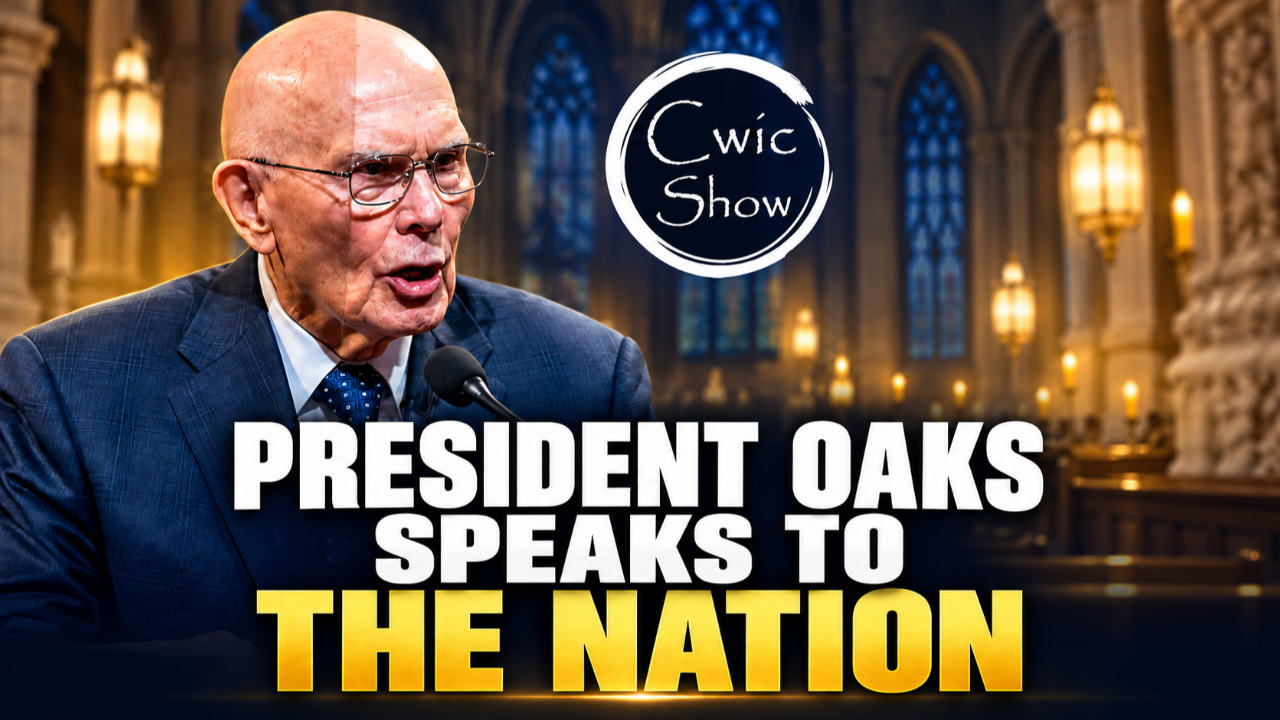
President Oaks at the National Cathedral on freedom, the Constitution, and the common good The Constitution as a Peacemaking Template: Sharia, Christian Nationalism, and the Limits of Peacemaking The Gap Nobody Talks About in the Utah Compromise Freedom, the common good, and what happens when the other side rejects pluralism
Raw Transcript:
President Oaks spoke at the National Cathedral last night in Washington DC, an address he called Freedom and the Common Good. Kind of bringing both of
these two sides together at the same time, juxtaposing them. And we've got some commentary on this. We've got several clips I want to cover, some
commentary to go with that. Essentially, the theme is peacemaking. This episode is brought to you by Warriors of Tiana.
This is a fantastic men's retreat. We had it last month in Rush Valley, Utah.
ended in a standing ovation. Great activities, expert speakers, a fantastic curriculum, it's motivating, it's
inspirational, it is challenging. This is not therapy. This is not self-help.
This is direct truth. There's nothing else like it out there. We're doing it again in January at Zans's National Park. Start 2027 off right. You can go
to warriorsofank.net to find out more and to register. Spots are filling up. I can't say enough how good this event is.
Would love to see you there. Here we go.
So, after watching this address last night, I had a lot of questions. I still have a lot of questions about this approach to peacemaking. I'm learning as we go uh what the prophets seem to want.
listening to President Nelson and now President Oaks. They're both hitting this drum pretty hard and they've both been aligned. They were very close. They
came in around the same time uh into uh the quorum of the 12 and they seem to be pretty aligned on this. I think that
there is confusion sometimes on this because sometimes people see peacekeeping as a a passivity. Uh that is not what he's talking about here.
He's talking about a way to live in a pluralistic society that I think is very important. and it is certainly part of the founding principles of America. So,
let's see what he has to say. I've got a few clips here and then uh I'll give a little bit of commentary on this.
2 minutesI am grateful to be here in this sacred setting with many scholars, civic leaders, and others I respect.
I'm here to speak as part of the National Cathedral's ongoing effort to find a better way to embody the love of
God in public life, offering hope for unity and a moral framework to move forward in a divided world.
In my professional work, I've always regarded the United States Constitution as a model for a diverse people to achieve self-government.
Along with Professor Yval Lavine and others, I read our history to teach that quote creating common ground is a key purpose of the constitution.
Okay. So, the constitution being used as a foundation here for his talk. In other
words, how do we create peace based on constitutional principles? Because that's what the constitution was about.
You had 13 different colonies. You had several different religions and belief systems. People coming from their own tribal uh mother countries uh with their
own cultures and their own ideas. And yet somehow they had to come together 13 different states. And then of course, not to mention the power struggle that
would exist with each of the states where you had, okay, you got somebody in charge of that territory. Do they still want to be in charge? You know, how do
you do this? How do you give up that level of federalism and and and supreme power, so to speak? Not really supreme
power, but more power to somebody that would be at a a federal level. And so that was all a lesson that we can draw
from on how to compromise, on how to work together and how to come up with solutions in a pluralistic society. The
constitution requires us to deal constantly with people who disagree with us. It compels a divided people to build
coalitions that allow them to act together for the common good.
There is no better place to study this than my native state.
He's going to go over here a little bit of the history of the church, which is great. I mean, so you've got a national audience. People are going to learn a little bit about the history. Very few
people know about the history of the church and the the the persecution that we went through and
how we had to deal with that persecution. How did Joseph Smith handle things? How did Brigham Young handle things in a very difficult situation
being a small small minority without support? All right, we got very very little support either from states or
from the federal government. As a writer recently summarized, Utah's history and Latterday Saint
5 minuteshistory in particular tells a tale of trial and error, push and shove, give
and take, compromise and concession as a quest for freedom, fairness and equality, moved along its bumpy, twisty,
neverending, and never perfect course." End of quote.
It really is right. It really is a great example of this to to look at the history of the church and how things were handled. And here we are now uh in
a position where yes, we're still a small minority. There is still hatred toward Latter-day Saints. Um but we have
emerged from a place where we were completely segregated, isolated, and misunderstood to where there's more and more information. Now, don't get me wrong.
There's always been a huge veil over the restored gospel and and and the restored church. And unfortunat, it's very
unfortunate. It's not surprising that that veil would exist. There are reasons obviously that the adversary has for
6 minutescovering those things up and not allowing these truths that we have, that we believe we have to to get out there.
But following the church history, you see so many instances of survival and
having by force to work with authority both from a state and a federal level and eventually he doesn't bring this up
but eventually an international level as well. I begin with some of our church members experiences living with serving
with and loving someone with whom we disagreed.
Here I mention our early history as refugees surviving expulsion from Missouri in the
1830s by a unique extermination order and in the 1840s forced to flee the
borders of the United States to try to establish a separate society in a land then claimed but not settled by Mexico.
Okay. So, starting off by expulsion and then how do we deal with things going from there?
In 1847, when our pioneers arrived in what would soon become the western United States,
their only governing authority was their church president, Brigham Young.
When the territory of Utah was created in 1850, he was appointed as its first governor.
In 1858, our unique status as a theocracy and a democracy
changed with the appointment of a new governor by the president of the United States. By the way, you don't hear that very often. A theocracy, which is
certainly what we had, and also a democracy to some degree. Um, very unique in the world. Very, very unique
to have both of those things. He was a gentile, as we then called all non-members of our church. We gradually
learned to live with dual authorities.
In our most recent history, we have survived the burdens of a small minority and the sting of rejection when our
differences of religious faith have caused some to deny that we are Christians and to reject our association.
I have brought this up several times and and again I I stand on a different side of the coin here than than a lot of
other people do and some of my colleagues do and in saying that we are Christians and we should state that we are Christians. It is important I
believe to to state this that does not mean that we are credle Christians. That does not mean that we accept all of the
history uh of Christianity uh coming forth from the first s first and second centuries. It it means that
we believe in Christ. And and I think that that position is very important to hold on to and not to let go and trying
to say, well, no, we're not Christian just because we don't agree with most of Christianity. And so again, here you
have confirmation of this. I believe their their position, the brethren, they've always stated this. They keep stating this. And so I think that we
should look at that closer. If you don't want to say we're Christian, you want to take a look at, hey, we're going to have this huge dividing line, which is
exactly what he's talking about, between us and the rest of Christianity, then reconsider, I think, reconsider
this and say, "No, we are Christian because we believe in Christ. We believe in the Bible. We believe in the
resurrection and the life of Jesus Christ, his example and his divinity. So nature of God is different. We believe in different things there. That's fine.
We have additional scripture. Okay.
But for someone else outside of us to define who Christians are, I to me that has a real pro I have a real problem with that. We define ourselves as Christians.
And I think that's a very important point to grab on to and be proud of. And if you want to put a qualifier in there
of non-credle, great. We are noncredle Christians. But saying you're Christian, I think is an important point. And in this world right
now where it seems like the most popular thing online, the most content out there, the most popular content is is
pushing us against, you know, it's the Trinity against the Godhead essentially.
It's bashing the Trinity. And and look, the Trinity is a problem. It's a it's a problem. But where that is built up that
it becomes that's kind of where the fight is. And I'm all for debate and I'm all for putting our points out there and
grabbing truth completely. But don't other Christians by othering us in in
using that term is is my suggestion. You might say we have become peacemakers
and advocates of freedom and unity by necessity.
as a religious person who has served in government at both federal and state levels and now as leader of the
worldwide church of Jesus Christ of Latter-day Saints.
I have always known of the tensions experienced when persons who rely on the free
exercise of religion are conflicted between duties to God and duties to country. This is
important. You know, part of life and and and really an understanding of your own values and worldview has to do with
a values hierarchy. What is more important and when is it more important? Sometimes things are more important now.
ometimes other things become more important later. But by lining up the values, the most valuable above all, right? And then the next thing and then
the next thing, right? God, family, country, you know, different things like that. If I put country first or I try to
equate country completely with God, there's a problem, right? I'm going to have a problem. Or if I try to even put
family above God and everybody else, you know, the mafiosos, that's, you know, hey, my family, everything's my it's all
about family. It's you you run into problems. And so here you've got a a a
values issue where you've got God and you've got country. Now look, we live in what I believe is the greatest country in the world and we have fantastic
values. That has nothing to do with the fact that we happen to be special people. It has to do with we the fact that we have special principles and a
special history and a special founding that we believe as Latter-day Saints was inspired and not perfect, but but
inspired. And this is what President Oaks is talking about and using that constitution and the founding of America
as a template for getting along and living in a pluralistic society. This is not about just the church, although it
does apply within the church. And we could have that as a different discussion because there are more and more diverse outlooks on life now and
viewpoints on life that are going to have to either come together as one or that we're going to have to deal with
each other. with with these different views in in a different way. Pluralism in the United States does not mean one
belief system is going to rule above all outside of a few of those very highest values and principles. Liberty as an
example, right? Pretty important. Let's listen to what he has to say here. More recently, I've come to understand better
the distress of other minorities who feel that some of us are invoking constitutional rights like free exercise
of religion and freedom of speech to deny or challenge their own core beliefs and their basic constitutional rights.
This is interesting.
What became the United States was founded and built by people of different nationalities, charities, and beliefs.
Its unifying purpose was not to establish a particular religion or to perpetuate any of the diverse cultures
or tribal loyalties of the old countries. Our founding generation whom
we honor in this 250th anniversary sought to be unified by a new constitution and laws.
That is not to say that our unifying declaration and initial constitution or the then current understanding of their meanings were perfect.
The history of the first two centuries of the United States showed the need for many important changes such as voting
rights for women and particularly the abolition of slavery.
Okay. So what is he saying here? I mean getting before we get to the the voting of women the 19th amendment and and the abolition of slavery.
uh he's talking primarily about the LGBTQ community because this is his history and going back to the fairness for all the act uh in Utah in 2015 and
then the RFMA later on a couple of years ago at a federal level. Um but you're both very very interesting positions for
what seems to be what used to be until a few years ago the most conservative large denomination in the country. And
so this is his idea on compromise. And so he's talking about not establishing a specific religion. Well, certainly
that's true. I mean, what are the issues that we have today on this? You've got looking even at the uh um oh gosh, what
is his name? The pastor and advisor to Hegath, right? The the uh the department
of war chairman um or secretary. He you know this they're they're Christian nationalists. And you say, "Well, okay,
I'm fine with that. I want to be Christian. I want Christian values in the United States. The Constitution was built on Christian values by Christian
people. That's all true. And there is a line there. Um, but what they want is
not a pluralistic society. And you can argue that. You could say, okay, well, we want a different society, and that's what they do that is built primarily,
not primarily, but totally on the Christian faith. to the extent that they
want to put penalties and consequences of law in place that are similar to the Bible, including the Old Testament eye
for an eye type thing. Very, very brutal, difficult consequences
uh for for breaking certain laws. And so, basically, what they're looking for is a theocracy.
And there is a difference between having a theocracy and having plural pluralism, right? So, so that's that's what we're
looking at. And trust me, if Christian nationalism took over the United States, you would not be in a good place as a
Latter-day Saint, you would be the enemy because they'd get rid of the Muslims and everybody else to begin with, but
but you'd be the primary enemy at that point. And and it's always important to remember this that
we might fight for several of the same political uh uh goals as a lot of Christianity
does, but there is a a portion of Christianity that wants to aggressively
um place Christian law so to speak into place making us a theocracy. That is
different. That is different from founding Christian principles that are put in place. And and and that's what
the United States is. It's founded on Christian principles. And make no mistake, liberty and the doctrine of Christ go hand in hand. They're handinand. You cannot pull them apart.
But if you are the doctrine of Christ is not going to say that all of all of uh
uh the United States is supposed to fall under a specific biblical law. That is not what is happening and that is not what makes this place thrive.
You might say, "Well, isn't that what Joseph Smith wanted? He wanted a Zion." Yeah, sure. That's different. That's a place that people can get to that choose
to go there, that choose to get to that position.
But we are not in that position. We are in a temporal position uh in a fallen state. And pluralism is what allowed the church to grow in the first place.
As difficult and brutal as it was in our history, it's what has allowed us to be able to grow in the freest land in the
world. Not free just for certain Christian groups, but free for all.
Now, here's the question that comes up now. Right now, you've got all this immigration that's been coming in. And so, you've got people from a different different lands, and I'll say the words Muslim Islam. That's that's difficult.
Most Muslims are going to be very friendly and are going to be um um
willing to Americanize enough that they can fit into a pluralistic society. I know several of these Muslims.
However, there is a decent percentage that do not want that that they are going to fight for Sharia law. Now, once
you get to that point, it's not you can't have a pluralistic society. It doesn't work because Sharia law fights
plural pluralism. It fights liberty. And so once you go to those highest core principles of a founding of America and
what we are built on, now you're you're in you're in a problem. And and the difficult thing there is peacemaking. So
these are some of the questions I have after this speech. Okay. So what do you do in that instance? What do you do with people that are so converted to a
certain way of life that want to change law and and this is not just Muslims? This is not just
Islam. This would be um you know those that are far on the left that want to bring in Marxism
and they're doing it to some degree in different places. Again, anti-christ that's anti-Christian. It's very
anti-Christian, antirist. It's very secular. And so how do you deal with that? Because that's another religion.
That is a religion as well that people are converted to that fights against those highest core principles. For me, I look at this speech and I say, "Okay, this sounds perfect. This sounds great.
And this is the way that I should act in in in offering charity to those that are my adversary."
In other words, always understanding their identity as a child of God. That's hard when they're that radical, right?
when they're that radically different and and against liberty. However, it's possible and it's something that we
should fight for. But I would never relinquish the line in the sand, the
wall, the concrete wall of liberty um as as the general principle for our land. And I would fight for that, right?
I would give my life for that because you can't you can't relinquish that because then everything falls and everything falls into tyranny. And that
I believe is supported by God and it's supported by the history and and lessons learned in the Book of Mormon where they
were constantly fighting off the dissenters of their own land, not just the Lamemonites. It's the book is really about the dissenters
and fighting them off, letting them be who they are for the most part until they were attacked by them, but
preaching the gospel, preaching true principles to those individuals uh when they were in the land. And and
so that's kind of the approach I think that that we're supposed to take. Just a little bit of a tangent there. Let's keep going here with President Oaks.
New laws had to ensure that those who had been enslaved or disadvantaged would have all the conditions of freedom.
Speaking for my own church, the US Constitution is of special importance to our members. We have a revelation that
identifies the Constitution as divinely inspired.
we see divine inspiration in and I hope we can remember that. You know, sometimes I'll talk about this like I even brought up 911 a few days
ago in in a Facebook post and and um sometimes I'll bring things up about uh
being an American and being proud of it and and a lot of people are like we're a global church now and and why would you talk about this or bring this up? It's
like no I I I believe in the the liberty. I believe in freedom and as long as America is espousing those things, I'm going to support it and I'm
going to be proud about it. I'm happy about this. And so, and I think that we should all be that way. And the Constitution sits in the Doctrine of
Covenants canonized as being inspirational, uh, as being brought about by inspiration from God. So whether you're
an American or not, the Constitution and the values and the founding of America and what happened there is a light to
24 minuteslook toward for the entire world. There were I don't know if there were any constitutions, very few if any at the
time of of 17 uh what was it 87 that was finally ratified and now there are hundreds right of of constitutions that
help support people. nothing quite like the United States but it was a ripple effect throughout the world and it's
continually is and poverty has been uh improved drastically level of living and
for quality of living for the entire world has been raised because of these principles and you which makes you
wonder why people are trying to fight it. It's pretty concerning that people won't want to fight against these things, but you
get emotional about certain things and you start getting bad ideas. But the constitution is inspired and I will
support it always. And I think that anybody who believes in freedom and liberty and the doctrine of Christ should be supporting the principles
of the Constitution. Not all the actions of the United States, not all the actions of the military, not all the actions of the politicians, not everything that is voted for by the
people, but the principles of the constitution should be supported and and talked about everywhere.
The vital purpose of the entire constitution which is that we are to be governed by law and not by individuals.
Our loyalty is based on the constitution and its principles and processes, not to particular office holders.
In addition to these foundation commitments to freedom and unity are a few corollaries.
As a practical basis for unity, all of us should accept the reality that we are fellow citizens who need each other.
This requires all of us to obey some laws we dislike and to live peacefully
with some persons whose values differ from our own. So here's where it gets dicey to me is it's kind of like okay
well we're supposed to live with laws that we don't like.
Of course, I mean, you have no choice, but that's what politics is so much about is changing laws or defending
laws. And And so, where do you what where do you go there? I I I don't think he's saying I think he's saying as a
general principle. Correct me if I'm wrong. I think he's saying that as a general principle, we need to accept the fact that in a pluralistic society and
even in a non-pluralistic society, you're going to live by laws, statutes, and policies that you don't fully agree
with. That doesn't mean you don't go and try and change some of those because you believe in something different. I don't think that that is a problem. I don't
27 minutesthink that that has any issue against what he's calling peacemaking here. In fact, I think it's your duty. We've been told many, many times from the pulpit in
Salt Lake to make sure that you vote and that your voice is heard. And so that, you know, again, parse it out. Parse it out.
We should be especially careful not to seek total dominance for all of our own positions.
Christian nationalism would be one of these. I'm talking full-on Christian nationalism. And of course, Sharia law would be one of these.
Even though the first amendment obviously guarantees the right to exercise or practice religious beliefs, that vital right is not absolute.
Advocates for absolute religious freedom should yield to the reality that in a
nation with citizens of many different religious beliefs or disbeliefs, the government must sometimes limit the
right of some to act upon some of their beliefs when that is necessary to protect the health, safety, and welfare of all.
Okay. So, well, we've certainly had examples of this. I mean, you got polygamy that was uh removed or partially removed in 1890.
Um, you have the fight in the state of Utah that went on forever over things like alcohol and cigarettes.
Um, and whether those would even be allowed. I think there's a compromise you can say there to some degree where there's I think lower levels of alcohol.
I'm not sure. I don't live there, but lower levels of alcohol in in beer and and other things like that. Uh but it's an interesting thought, right? I mean,
we need to be willing to give up a few things to practice our religion. So, as an example
here also, I mean, if you're Jewish and and you don't want any pork around anywhere, well, are you going to
fight for dominance for your religion by saying, "No, these places, I don't want any place that is around me serving
pork or any food that's not kosher." Right? That that's an example of that.
That makes sense. We live in a pluralistic society.
We need to work for a better way forward. A way to resolve the differences without compromising core values.
We should seek fair without compromising core values. Then he's going to use this term here, fairness for all.
Fairness for all. That's the thing I don't understand. I'll be honest. I don't understand. He uses this. This is
what the act in 2015 in the state of Utah was was nicknamed basically is the fairness for for all act. And I'll get
into that in a minute because I think he's going to cover this more here.
30 minutesThis is not easy when we differ on what are fairly judged as fundamental rights in a pluralistic society.
As our friend, Professor Robert P.
George said, quote, "We need to remind ourselves that our fellow citizens with whom we disagree, even deeply disagree
about fundamentals matters of justice and the common good, are not our enemies." End of quote.
Now, this is kind of an interesting statement also because earlier on in this address or in a previous address, I can't remember which one it is, he
talked he extends the idea of loving your enemies as as working in peacemaking and and in other words, working with those that you don't you
don't agree with. And and here he's agreeing with the author George saying they're not your enemies. And so
obviously there's a there's a different connotation in each of these examples for the term enemies. Love thy enemies
can be used in a positive way to say love those you disagree with. And and
then he's also saying here but you they're not your enemies the ones you disagree with. So just words are
interesting and they're important especially in a very postmodern world that we live in where postmodernity has
postmodernism has has destroyed uh or had the goal of destroying our language.
Regardless of what some people say that I've seen post things lately, the goals of both sides are best served
by resolving differences through mutual respect, shared understanding
and good faith negotiations and all participants must accept and
respect the rule of law. A beautiful place. Far from being a weakness,
reconciling adverse positions through respectful negotiations is a virtue.
As Jesus taught, "Blessed are the peacemakers, for they shall be called the children of God."
As noted at the beginning of my remarks, the Constitution compels a divided people to build coalitions to allow them
to act together. again, he's using the founding of America and the Constitution as a template for the way that we should be acting.
Now, here's another thing that comes up in in his discussions. Um, and it's mostly him and Elder Kristofferson, who also has a law background. He's an
attorney and and sometimes Elder Cook, who's also an attorney, that talk about this this principle of religious freedom. But there are times when I'm
listening to these men, these great men that are um they're speaking from an approach, it appears to me, where they're talking about things
institutionally and not individually. In other words, institutions need to work this way. He could be talking about the institutions
uh the institution of Christianity and and the churches and how they need to act as the heads of the churches and and
the leaders of the churches. And then of course in in in other civic organizations and with uh academia and
with uh so so the heads of the universities right and and the government and so sometimes he it seems
like okay he's talking institutionally and sometimes he is and and not individually. The question is is where does this apply for me?
Question is where does this apply institutionally and where does it apply individually because it's not always the same. It's not always the same thing. As
an example, you're asked from the pulpit uh to vote and to go out and make your
voice heard and be involved in your communities and so that includes politics and service and everything
else. However, the church except in rare cases which was very another very recent
one today in Idaho or recently in Idaho um does not get involved in those issues. So at an institutional level
there's one way that the church approaches things and then it expects its members of that institution to act in a different way and they do have
different roles and so different rules sometimes apply to those things.
So that's sometimes I'm listening to this I'm like, "Okay, does this apply to both?" Now, when he finishes the speech, he's talking about individuals. I don't
know if in his mind he's specifically talking individually when he's going over some of these things as he's
talking from the national cathedral to a a to everyone obviously but but
you've got heads of state, you've got you've got uh you know heads of churches that are here and and there are sometimes different rules between the institute and between the its members.
The Fair ForAll act of 2015 is a perfect example of that. Again, I'll I'll get to that in just a second. Compels is a
strong word, but it is exactly what the Constitution does. It puts what we now
call peacemaking at the heart of the Constitution's process for achieving freedom and unity and fairness for all.
I appreciate what David Brooks said in his final column in the New York Times.
Despite what the cynics say, I still believe we're driven not only by the selfish motivations,
but also by the moral ones, the desire to pursue some good, the desire to cooperate, to care for one another, and to belong.
End of quote.
Unfortunately, what Brooks called moral motivations are rarely given the time to prevail by a peacemaking process.
But there's one outstanding example. The history of the so-called Utah compromise.
The issue there was a Salt Lake City ordinance on housing and employment first proposed in 2009.
This was a head-to-head conflict between the free exercise of religion and nondiscrimination.
The Church of Jesus Christ of Latter-day Saints and nondiscrimination advocates,
adversaries in that contest, reached out to each other and participated in negotiations.
This was previously thought impossible.
However, both sides learned to understand each other's positions, including what they deemed most
important to be protected by law. The two sides worked together with the Utah legislature,
which amended the Utah Anti-Discrimination Act in 2015.
This outcome offered protections to both sides.
One side obtained significant legal protection from discrimination in employment and housing.
The other side gained protection for religious freedom in its most sensitive areas of church employment and student housing.
Okay. So here here's the point that I wanted to bring up here. Uh in 2015 when they were working with this and they called it the compromise. Basically,
he's talking about the LGBTQ community and in the areas of employment and housing that they were they were not going to be discriminated against,
38 minutesright? And and so that was conceded. Uh the concern there for the church who has heavy political
influence in the state of Utah was that if they go through this that that's going to mean it it's going to affect it can affect the church. It can affect BYU
as an example and the student housing there. uh which they didn't want to have. They don't want same-sex couples
uh being in student housing and and things like that. And so what they ended up with was a compromise. And this is
something that President Oaks has been championing. And that's why he's bringing it up here since this time. And
since this he's also gone and and and given support to the RFMA, right? The the reformed um
uh the Reform for Marriage Act, I believe it what it was, the RFMA, and that was a that was a national thing, something that was very similar to what
was done with the Utah compromise. But the Utah compromise is again, it's institutional. It is not individual.
So what I mean by that is that the the institution of the church is protected which most of us want. We want them to protect be protected in this manner. We
don't want that moving in toward that inner circle of same-sex marriage in the temple. Right? You have to perform this.
And that fight will never end. I I I you can be as big a peacekeepers as we ever want to be. That fight will never ever stop. That drive will always be there.
However, uh it protected the church and gave them more rights for for freedom of religion at an institutional level and
and for things such as like owning BYU and a and a church school and how things could be handled there uh with housing and on campus.
So, at an institutional level, it's great, but it had nothing to do with individuals. What do I mean by that? I mean, it didn't protect, say, a small
business owner from the Colorado issues, right, of I have to bake a cake for so and so because and for for a gay
wedding. It it didn't protect you for a number of different things. In fact, it pretty much the opposite. It it it it
it's again there's just a big divide between the institution and the individuals. That's why with the RFMA later on, several years later, that was
very similar to to the Utah compromise, Mike Lee never signed on because he's like, well, if you get this these rights not just to the
institutions, but to individuals also, then I'm on then then I'll sign this.
So, he never ended up signing it for that reason because there was that gap between the two of them. Also, I know
this was tried in Arizona and I think the church tried to back that up and get that done in Arizona. Uh, it never even made it to the floor. I don't know if it
did later on, but I know at the time during that year and the following year, it never even made it to the floor for a vote.
So, there wasn't any support for it. I don't know if anywhere else right now in the country, if other states have taken
this on. you've had a lot of support for it from journalists
and and authors that have supported it and uh like the the person he's quoting
here and and uh boy there's another guy that's been making the rounds quite a bit at BYU and
other places. I can't remember his name right now, but you know that's that's so there is support and I and I think that this is something President Oaks really wants to get done at at a higher level.
I the the problem I think for the support level and the voting for this is that there's no individual protection on it. It it's purely institutional. And so
you've got people coming in to vote for the institutions where you've got the, you know, on one side and then you've got the people that
want to vote for their own their personal rights and and so it's kind of lopsided in that way. So that's why I think he's had some difficulty in getting some of this some of this done.
Good examples of this are the effects of our church's helping hands program.
These volunteers in yellow shirts, tens of thousands of them, help clean up
efforts to relieve destruction and suffering from natural disasters and serve in many other humanitarian projects worldwide.
You know, this is something that's nice, right? When you're you're you're helping other people and you're in the mode of service, nobody cares about what your
religion is. Typically, they don't care about what your political beliefs are.
or you're working with something that's much more important than any of those things and an immediate usually urgent need. Uh so it is a great example of
this and I've been always proud as a Latter-day Saint to to see the efforts of the helping hands people that have gone out and and helped in so many different natural disasters.
In the process, relationships are formed peopleto people that would be impossible by institutional declarations.
There's an important lesson in the helping hands experience.
It is an effort that brings peace to people who are in distress.
But it also teaches us the power that comes when individuals put aside their differences and work together to find common ground.
When our volunteers bring help, people in distress do not ask for their beliefs.
Likewise, the volunteers help everyone, not just fellow believers. Why? Simply
because deeper moral needs about safety and family and hope take center stage.
People of goodwill, compassion, and a desire to understand and help one another are at the core of peacemaking.
All right. So, I think there's a really good point here that he's making. I'm going to let him finish up here in a minute, but it's
when it naturally doesn't matter your differences, then people get along well.
When you go to the temple and everyone's dressed in white, there's a commonality there because not everything about your
belief system, about your life is on your sleeve for everybody to see.
And so by necessity, by urgency, by service, you can be in a position where it doesn't m none of these things
matter. And that's always so nice to to get beyond the differences and and to be in that position where it's human to
human and it's just one human helping another. So I do think it's it's a great example here. Let's let him finish up now. The same is true of fairness for
all in the constitutional processes of achieving freedom, freedom and unity as
difficult and slow as it is. It's all about trying to understand the deep needs, the deep commitments on both
sides and then to forge solutions that yield peace and fairness for all.
Knowing that we are all children of God gives us a divine vision of the worth of all others
and the will and ability to rise above prejudice and racism.
As I have lived for many years in different places in this nation, the Lord has taught me that it is possible
to obey and seek to improve our nation's laws and also to love our adversaries.
Okay, so just real quick, while not easy, seek to improve our nation's laws. He's not asking you to stop to just let
everything be. we get into this idea where oh you don't you want to be a peacemaker because you're trying to get something done. It's about how you're
doing it and it's about are you treating people with respect and and as a child of God which we all have difficulty doing sometimes right but but it does
not mean that there is no conflict and we need to get that out of our heads.
Peacekeeping doesn't mean there's no conflict. The very purpose of peacekeeping is that there is conflict
there and and that that you're trying to get through the conflict and the only way to get
through the conflict is dealing with the conflict is going is having conflict.
Conflict is going to be inevitable. No matter what we do uh as a church, as as individuals, as Latter-day Saints, as Babylon in the
world moves further and further away from us and that chasm gets greater and greater, there's going to be more and
more conflict, right? There will be more and more conflict. The question is is how do you work through that? How do you deal with
that? And I think that that is part of the purpose of the focus on the peacekeeping is because there's a knowledge that the world is going to try
and divide all of us including the church and the world is going to uh go further and further away from the principles of the gospel.
And so with that move and that untethering away from truth and true principles and the con natural contention that is
going to be there then how do you work with that? How do you deal with that? and and we should
deal with it and we should we're I think we're being asked if you're going to be a peacemaker then that is an action and
and it is a matter of okay I can maybe compromise on a few places here for plurality
however however there are core values that I'm not willing to negotiate on
and I think that he would say the same thing there are certain things that he he would never negotiate on and he would protect with everything that he could.
But in a pluralistic society, there are a few things that you have to give up.
This is very different. Very, very different. I hope we can see this. You know, you've got the AI tech giants
right now that are in all part of this movement of effective altruism.
That is the greatest good for the greatest amount of people. And all it is is a a nice fluffy label for eventually
for Marxism. It's the same concept, same collective concept, just a different approach, a more sophisticated approach.
And it's that's not what he's advocating here.
49 minutesI I I don't believe that for a second. Peacekeeping. Look at the life of Jesus. Did he treat everyone as a child of God?
Was he angry at people sometimes? Did he use names sometimes and call people names? Hypocrites, vipers.
Um, did he untether from the truth when dealing with others?
When the rich man came to him and Jesus said to him, "Leave everything, right?
Give up all of your all of your wealth and come follow me. That's what it takes." And the and the the man said
basically, "No." Oh, and he walked away disappointed. Jesus didn't go after him and say, "Oh, okay. It's okay. It's okay.
You you can you can just come as you are. You can just follow me the same way as you are right now." Right? So, so I you know, make sure
you're using scripture here to understand all of these very inspired principles that the prophets give us. I
I think that's an important thing to take a look at this to be able to parse things out on this and to think about it critically and understand what's being stated. Let's have his conclusion now.
What makes it possible is the help of our Lord Jesus Christ.
He gave this commandment to love and he promised his help as we seek to obey it.
I close with a prayer here in the National Cathedral, the house of prayer for all.
I pray to our heavenly father for his blessings upon us that we will all seek to be peacemakers
in the name of Jesus Christ. Amen. Amen.
So, great speech, uh, great address. I It makes me
feel really good. I mean, think about you've got a lot of good people in in a lot of good institutions and in
throughout, for example, Christianity and other faiths, a lot of really good people, but you're going to be
hardpressed to find 15 individuals that have the quality of of
I I I don't know how to say goodness and and beyond that, part of that goodness is competence. Part of that goodness is experience. Part of that
goodness is the calling itself that gets placed upon these men and their willingness to live up to it and to take
on that responsibility as apostles of of of Jesus Christ. just so grateful to be a member of the church, the true church,
and the gospel is true, and these principles are important, and I believe very firmly in the idea of of the
52 minutesConstitution and the founding of America. Thanks for listening.

"I Take This Every Day!"
Learn more about why I accepted Cardio Miracle as a sponsor and why I take it every day!
- Greg Matsen

Stay Connected With New Articles & All Things Cwic!

Cwic Audio Player
All of the Cwic Media podcast episodes on one page!

